My Digital Portfolio

Author: admin

Journeys and Schmidt Scholar experience

Agnes Scott has a tradition of sending first year students on a week-long travel excursion to selected sites around the world. Students take a class during their second semester to prepare them for travel and are accompanied by a faculty advisor, and a student leader in addition to their Professor. Student leaders, known as Schmidt Scholars, are selected out of a pool of applicants based on merit, experience and academic interest. I applied to become a Schmidt Scholar for the 2022 academic year for a Journeys trip to Tuba City, Arizona on the Navajo Nation.

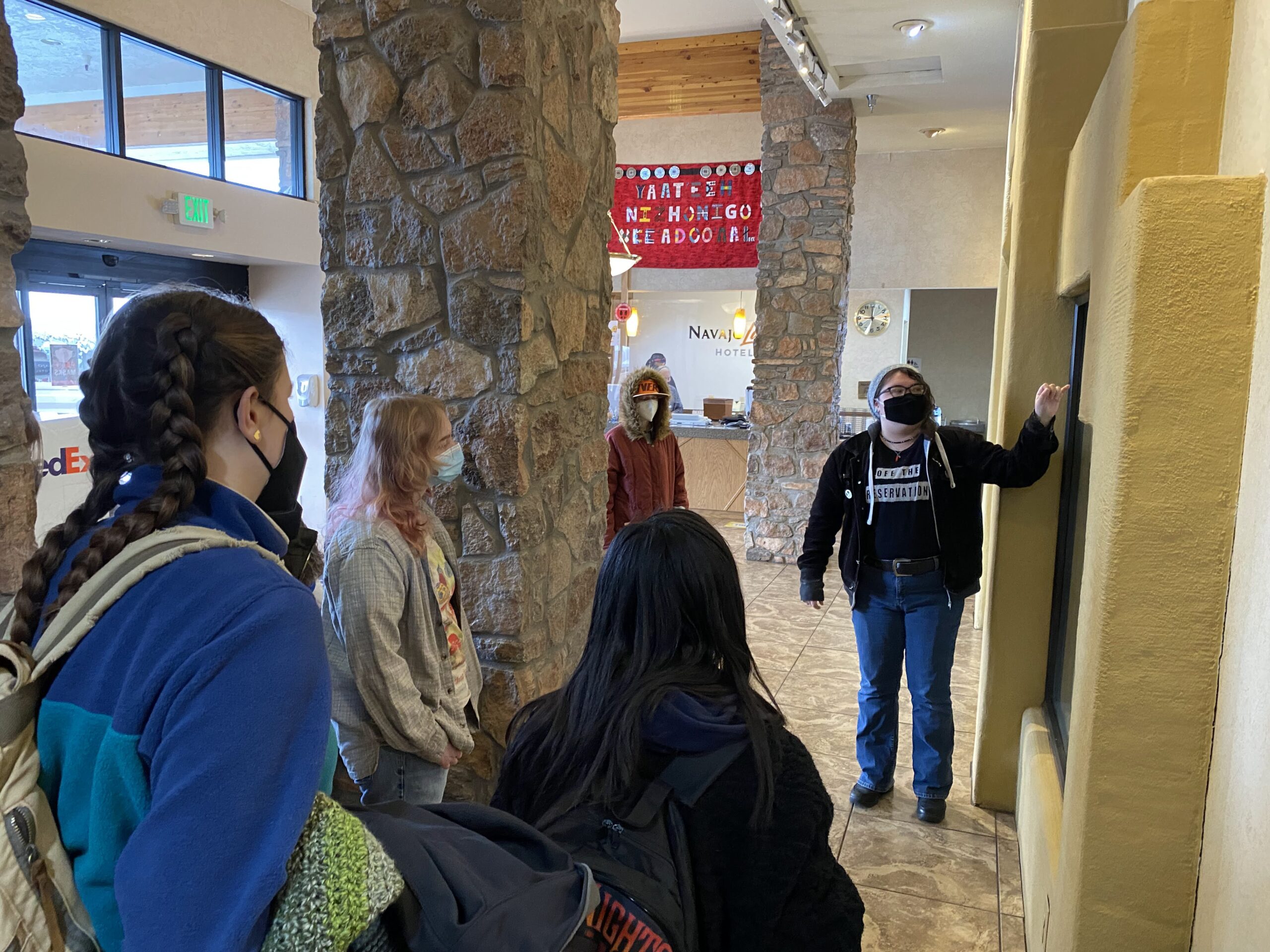
Giving an impromtu lecture on the photos in our motel while waiting for our vans. The motel displayed photos of Navajo and Hopi people going about their daily lives, I started talking to one or two students and soon more gathered.

As a member of the Navajo Nation I decided to give back to my college by helping teach the course and accompany the new students. I created lessons for the class and led discussion on subjects and parts of the culture I am knowledgeable and passionate about.

During the trip I accompanied my students on service projects for the community, lectures by community members and teachers, and educational trips. We attended notable locations such as local museums, trading posts, and even the Gand Canyon for a hike.

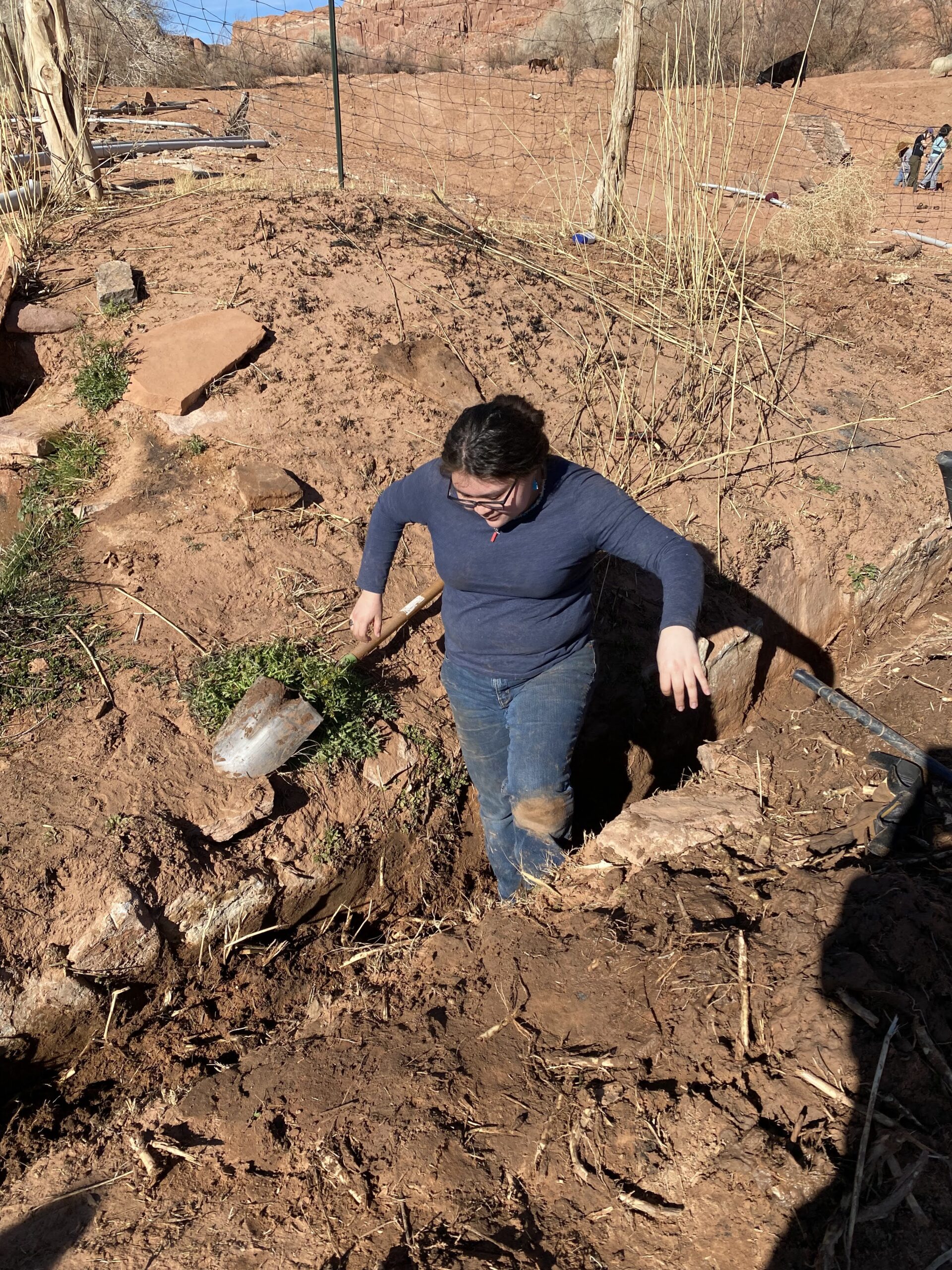
One of the community service projects our class engaged in was farm work. I worked alongside my students and together we reopened an irrigation ditch on our community host’s farm land.

The Schmidt scholars program was an invaluable experience and taught me about planning and mentorship as well as cultural facilitation and communication.

Beautiful Question

“How can we influence social change, if culture and race were portrayed differently in the media?”

Questions are easy to come up with, however, certain questions are so simple that the answer is complex and the outcomes numerous. This question seems soft, simple and yet has no definite answer, when it comes down to it. Berger defines a Beautiful Question as “… [an] ambitious yet actionable question that can begin to shift the way we perceive or think about something…” This question fulfills all these requirements as certain parts of the media; new-stations, movies, shows, etc., will take time to change. As discussed by Professor Hayes’ rotation, and professor Paul’s rotation, stereotypes and prejudice are often integrated into society, and take time and effort to change the parts people see.

There is no question that the “Gatekeepers” of our society shape how the everyday American sees the world. So, it seems logical that refereeing to the entire human race as divided amongst itself both mirrors and reinforces the fact that the U.S. makes humans and their skin-color a controversial subject. For example, Professor Hayes’ rotation had us discuss how pop-culture influences our perceptions of what is deemed exceptionable in the media. From street gangs and Natalie Wood playing a Puerto Rican incarnation of Juliet, to how the sensation Hamilton has changed perceptions of history and the Founding Fathers, pop-culture shapes our views of everyday life. Diverse cultures have historically struggled with representation in the media, from having being underrepresented as a whole, to being passed over from partaking in the media.

In Professor Paul’s rotation, we had a discussion about microaggressions and stereotypes being ingrained in civilization. Reactions to different practices and beliefs are dependent on how we are exposed to those differences in our everyday lives. The media is a big part of the thinking that leads to the dividing and damaging reaction we have to difference.

The term “race” for instance, is supposed to refer to a separate and unique species of organism. Using the word “race” in place of “ethnicity” when talking about people, gives the public the impression that skin-color is indeed a divide that allows people to distance themselves from others. Additionally, the ethnocentric recounting of history is a divide that tells us it is okay to remember deeds of large global giants, rather than focus on the cultures and lively hoods that were damaged, erased, and oppressed, to get where we are today.

This distance, this distinct divide, is the foundation for racists and superiority thinking in general, as “racial differences” are little more than culture and pigmentation. By starting small, perhaps with small time TV shows and local and liberal leaning news stations, using other terms for “race” such as “group,” “ethnicity” and “culture,” maybe the small, slow shifts needed to make the move. Next schools when talking about biology and history can implement the more diverse retelling of historical context and cultures, and why in the context of human relations it is important to hear more than one voice. Tolerance and acceptance of people can begin by highlighting “differences” and make them obsolete through accurate representations of people and the social, cultural, and political environments in which they live. 
Local Travel-Art around campus

The art present on the ground of Agnes Scott appears to be as diverse as the students who study on its campus. The art scatter across the the floors of each of its buildings range from paintings and sketches, to prints and photographs.

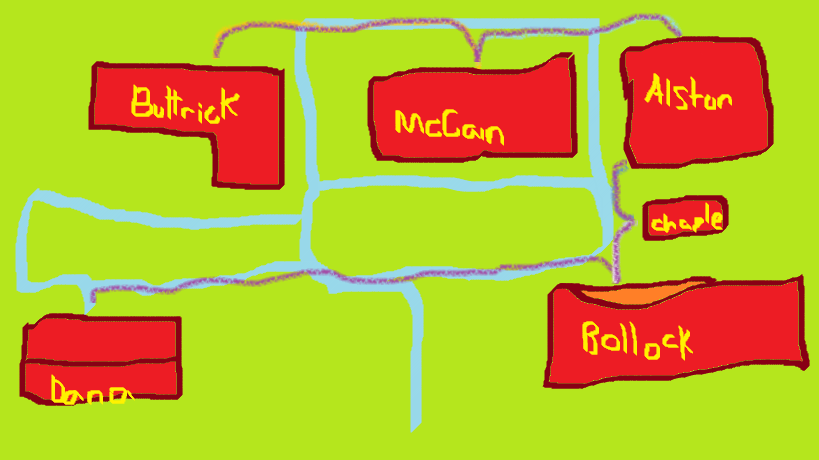
From this badly drawn map, My path around campus in the purple is shown. I began with Bullock, the science center, I found no great attachment or draw from any pie of art, mostly plant images and portraits of past benefactors.

I then entered the chapel, finding mostly small newspaper art and large, circular abstract pieces.

I moved on to Alston, with its many portraits of women and abstract female form. Many of the most moving pieces were done in charcoal, these had a solemn, almost peaceful feel.

Next was McCain Library, home of the most diverse and interesting pieces, Asian brush paintings, photos, portraits, and wooden block prints abound. These bits of art were more finely detailed then most of the arts in previous buildings.

I concluded at Buttrick, Many of its few pieces were similar to the wood prints found at the library.

The amounts of art and overall expression on campus seems to mirror the spirit of the student body, decorated by contributors of the past, watching over the campus, there is also the occasional pull to color and shape. The campus itself is expression upon expression, all unique, and yet all stand out in their own way.

Expectations from this Trip-One Thing I Wish to See

One of the biggest reason why I wanted to visit DC for the first time, is because I have had family members fortunate enough to visit; the reason for this visit was for the dedication for the Korean War memorial, of which my great-grand father was a veteran. Museums and art will be fun as well, but I would like to visit war monuments like the Korean one, to pay my respects.

A short Cover letter/My LDR Reflection

My understanding of my own leadership capacity has morphed into a better understanding of my drawbacks and strengths. Going into my first Leadership 101 class, I had a very clear idea about how I would choose to lead: I prefer to think logically, realistically, and think about what would be better for the group as a whole. Initially I went in thinking I would develop a strong sense of  camaraderie with everyone I would work with, that I would not be afraid to speak my mind, for fear of rocking the boat, and that I would make frequent contributions reminiscent of back seat driving. While this all proved to be true in a way, I was challenged and met with a little more resistance then I was used to. I was met with a class of people who admittedly, had very similar ideas to me, but had different takes on what that meant. I also had the privilege to talk to and work with others who were different enough to challenge my own ways of thinking and planning. I do believe I went in knowing how I prefered to lead, and how I preferred to work with others, but I also believe I came in knowing that my style of leading was in need of some experience.

Before my classes in college, I was often someone people could turn to; I was in the top 10% of my class, I was willing to speak-up, present and make speeches, and there was always something I could add to make things work. Projects, assignments, jokes, a conversation, I always looked to bring more, and in this class I found there were ways to recieve. My peers thought like me, we had similar trains of thought and conclusions, but there were also many twists and tunnels that always made sure we stood out from one another. In class we could be given something, anything, and be told to read, analyze, and discuss. I felt like the discussion would be mediocre at best, imagine my delight when someone would point out a heart-wrenching quote about animal cruelty and make me think about it in terms of people, or when a someone on a different occasion pointed out in an Op-ed that the writer was passive and looking for attention. Conversation pieces that I couldn’t fathom coming up.

Additionally, I found that working in a group the way I tend to might not always work. In a class where everyone is expected to be a leader, there are about to be some issues and complications because everyone is taught to lead their groups into battle. I prefer to either lead by steering the group into what i believe is the right way for us to move, or to be the head of the whole operation because I’m a big sister and some of my best friends from high school were underclassmen who didn’t want to work half the time. It’s different, as class groups taught me that I needed to present myself as an equal, no herder, and no boss. In order to make a turn in a group affair, of to even make a compromise, I needed to be strong and flexible in order to make things work. This class had taught me manything about how my leadership skills need to evolve and hopefully this is still the edge of an iceberg.   

D.C. Food Analysis-The Half-Smoke


A half-smoke is well known to be Washington D.C.’s own creation and invention. It is basically a type of sausage/chili dog that was created around the Washington D.C. area with a foggy history; there is some debate about what the name means or where it came from. Some suspect the sausage hints at its ingredients, a half-pork and half-beef smoked sausage. Or perhaps the name hints at how the food was cooked; half-smoked and half grilled. The sausage is smoked before being grilled and topped with chili and cheese, sometimes onions or a bit more. Generally spicier than the average hot dog, the half-smoke contains half-beef and half pork meat that is coarsely ground.

The half-smoke appears to be be D.C.’s own take on a great American pastime meal with a little bit of a twist. Fast food is a known American signature and has been served throughout the decades often grilled or fried. This hot-dog offspring takes a food that is close to the heart of many Americans and gives it a new twist and a bit of spice. The baseball and food cart food is now available in every corner of D.C. and is a very locally known food with many dinners and restaurants selling the novelty.  

American fast foods are known for being ubiquitous in towns and cities; making it high in demand and affordable to the average citizen. Like in New York City, this food is available at just about every street corner served on napkin, paper, or ceramic plates. Basically what you can afford to pay for this food is what you get. It makes sense, that the capital of the U.S. and the seat of political power has a signature dish that is inherently “American,” but has some spice added. It goes to show that somethings about the patriotic or “good ol’ American” lifestyle will never change. The food like it’s predecessor the hot dog, will endure and and remind one of old U.S. pastimes such as baseball, big cities, and grills on the fourth of July.

Some places go all out when it comes to presentation, the diner “Half Smoke” on Florida Ave NW in Washington D.C. presents the half-smoke in a lunch boxes by the waiters. Additionally the check arrives in old VHS covers.

Environmentally, the half-smoke shows another great American Pastime, demonstrating how Big Food and Agro-business are present in America’s everyday lives. The sausage is made of spicy meat containing both pig and cow meat, two animals known for their mass production and large water usage and carbon footprints. The food is also smoked and fried leading to big flavor but large pollutants as well. The food of course, is not healthy but is available for anyone to eat. The beans and fries were most likely grown by a large scale agricultural business of some kind before being harvested, processed, transported, cooked and fried. 

Overall, the half-smoke can be argued as America in a nutshell. A strong tradition meets a modern twist with a rich background.  

5 Strengths


My top five StrenghtsFinder themes include Input, Context, Intellection, Empathy, and Strategy; while empathy falls in Relationship Building, majority of them fall in the Strategic Thinking category. Empathy, those it stands alone, is one of my stronger abilities out of the five. Growing up, every new shock to my relatively happy childhood came from knowing of some far-off injustice that I could not fix or sooth. Whether it be of starving children I was told about at the dinner table, or a friend’s complicated home life I felt the need to do something because I could imagine their pain. To me imagining what certain situations could feel like gave me a sense of what can be done to fix certain situations. I have not been content to merely tell the stories of others, so their experiences become lectures used by well meaning parents at the dinner table. I want what I experience and collect to be presented to the people who can create change, and if so, become such a person myself. If empathy gives me a sense of other’s experiences, then strategic thinking can give me a way to figure out how to ease another person’s pain.

As a team member and a student in the Leader-101 Course, I feel that I can use my strengths to develop meaningful connections with people, not just as a friendly person, but as a teammate willing to see their thoughts and ideas from their point of view.  My strategic thinking abilities will then allow me to reword their ideas to better communicate them to the groups and explain it in different ways, so everyone can understand. Additionally, my thinking can help the group and I to brainstorm how to implement or expand on the idea, finding a way to put it into actions after everyone has had their say.


© 2026 I'm A Scottie

Theme by Anders Noren — Up ↑

css.php